



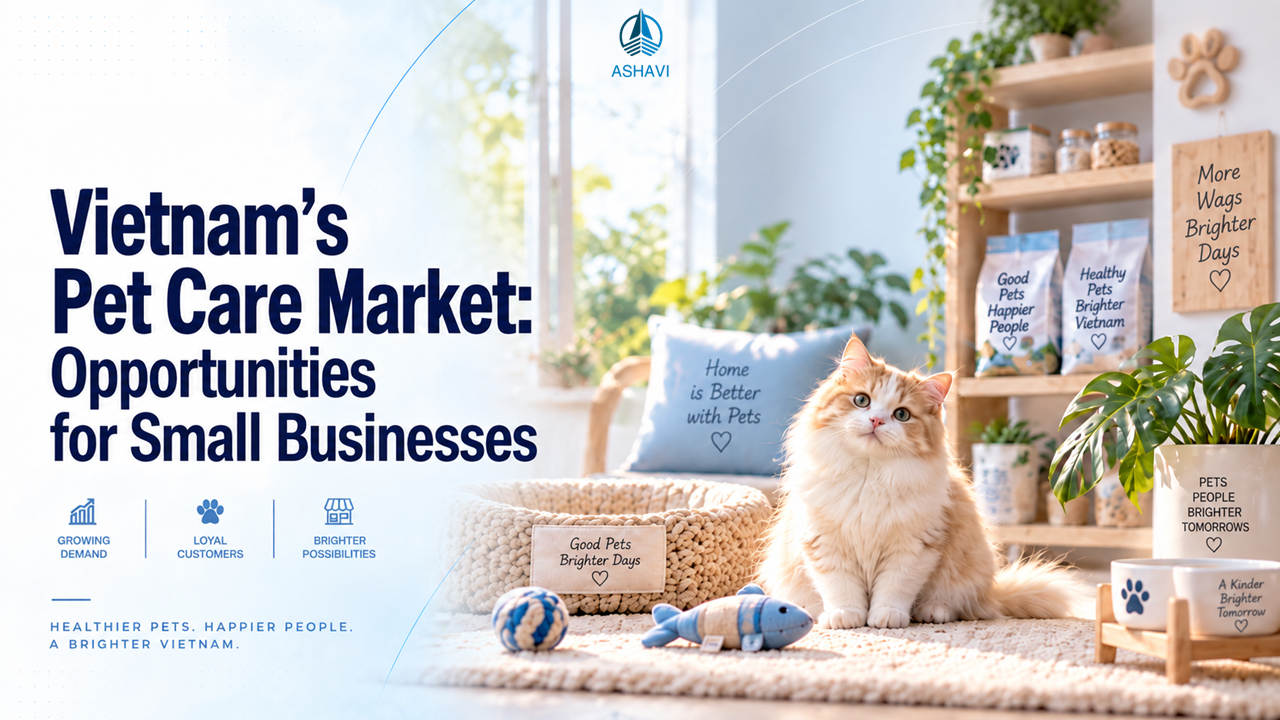
Walk through any residential area in Ho Chi Minh City or Hanoi today and you'll see grooming salons, pet cafés, and shelves of imported cat food. Pets in Vietnam are no longer just guard dogs or mouse catchers. For many families they are now companions, and increasingly they are treated as family members. That change has turned pet care into one of the country's most promising consumer sectors. Small businesses that understand it early are in a good position to benefit.
This article covers the size of the market, what is driving its growth, where the best openings are for small players, and how to check an idea before you invest.
Estimates of the market's size vary by research firm and by what each one counts. They all point the same way: up.
In pet food, the largest segment, Mordor Intelligence values the market at about USD 168 million in 2026 and projects it to reach roughly USD 242 million by 2031, a compound annual growth rate of 7.61%. IMARC Group is more optimistic: it put the pet food market at USD 153.9 million in 2025 and expects it to reach USD 342.3 million by 2034, growing at 9.29% a year.
Growth is not limited to food. Even pet insurance, a very new category in Vietnam, was worth an estimated USD 43.9 million in 2025 and is forecast to reach USD 103.5 million by 2034. A market in which people start insuring their pets is one where spending on pets is becoming more serious.
For a small business, the exact figure matters less than the direction. Demand is growing steadily, and the market is still young enough that no single player controls it.
Pet ownership has grown quickly. According to TGM Research, 74.5% of Vietnamese households owned at least one pet in 2024, compared with 67% in 2023. Ownership is also concentrated in the big cities. A 2025 study by Indochina Research found that around 25% of Ho Chi Minh City residents own a pet, while Hanoi and Da Nang are slightly lower at 18–19%.
The most important change is emotional. TGM Research reports that 44% of Vietnamese pet owners see their pets as family members and 31% see them as friends, and this attachment drives spending on grooming, which 54% of owners use, as well as on veterinary care and insurance. When owners think of a pet as a child, they spend on it the way they would on a child: better food, regular health checks, and treats.
Dogs still lead. Indochina Research found that roughly 7 in 10 pet owners have a dog and about 3 in 10 have a cat. Cats, however, fit apartment life well. Industry analysts note that cats are becoming more popular in urban areas because they are easy to care for and suit smaller homes, which should boost demand for cat food and related products. Mordor Intelligence likewise expects cat food to grow at 8.27% a year through 2031.
As the middle class grows, consumers are becoming more willing to spend on premium pet food and health products, particularly as awareness of pet well-being increases. 3. Where the Opportunities Are for Small Businesses
Large multinationals such as Mars and Nestlé Purina dominate packaged pet food. The wider pet economy, though, has plenty of room for small, local and specialized businesses.
Services are hard for big brands to scale and depend on personal trust, which is where small businesses do well. Grooming is already mainstream, and demand for boarding peaks around Tết and summer holidays, when owners travel. A clean, well-reviewed neighborhood shop that offers grooming, spa treatments and short-term boarding can build a loyal customer base fairly quickly.
Tip: Membership packages, such as a set number of baths per quarter, turn one-off visits into repeat revenue.
Physical pet stores remain the backbone of the market. In pet food, specialty stores held a 72.44% share of revenue in 2025. Owners like to see products, ask questions and get advice. A small store with knowledgeable staff can compete on service rather than price.
Health products are growing fastest. Mordor Intelligence expects nutraceuticals and supplements to grow at 11.62% a year through 2031, faster than traditional food. Small businesses can sell vitamins, joint-care products, or fresh and homemade-style meals, especially for older pets or pets with sensitive stomachs.
E-commerce is growing steadily, with the online channel advancing at a 9.33% annual rate through 2031. For a small brand, Facebook, TikTok Shop, Shopee and Zalo are low-cost ways to reach pet owners. Short videos of grooming makeovers or pet product reviews tend to perform well on social media.
Beds, clothing, collars, toys and carriers made in Vietnam can compete with imports on price and delivery speed. Local makers can also offer customization, such as a name embroidered on a collar or a bed sized to fit a small apartment, which imported brands rarely provide.
Pet cafés, pet photography, dog training, pet taxis and pet-friendly homestays are small but growing niches. These services suit owners who see their pets as part of their social life.
The opportunity is real, and so are the risks.
Before opening a store, taking over an existing shop, or launching a new product, the most useful step is to understand your target customers. Key questions include:
A short survey of local pet owners can answer these questions in a few days and at low cost. It can save you from expensive mistakes like choosing the wrong location, stocking the wrong products, or setting prices your customers won't accept.
ASHAVI makes this easy. With ASHAVI's AI-powered survey tool, you can create a customer survey in minutes, share it through Facebook groups, Zalo or QR codes at your store, and let AI analyze the answers, including open-ended feedback, so you can see quickly what pet owners in your area want. You can also use ASHAVI Forms to take grooming or boarding bookings and collect reviews after each visit.
Vietnam's pet care market is growing, driven by rising ownership, urban lifestyles, and owners who see their pets as family. Large brands will continue to lead packaged food, but services, specialty retail, health products, local accessories and lifestyle experiences leave plenty of room for small businesses.
The businesses most likely to succeed will be the ones that understand their customers best. Start with research, build trust through good service, and adjust as the market changes.
Ready to understand pet owners in your area? Start your free survey on ASHAVI today.